Landowner Rights & Trail User Responsibilities

The Waskahegan Trail is a unique resource that exists only because of the generosity of landowners. Before you set foot on the trail:

  1. Know the landowner rights and the trail user responsibilities.
  2. Check the trail conditions

Midwinter Whitemud Creek

Although the days are short and cold in Alberta’s midwinter, the clear skies and fresh snow can offer up brilliant daytime scenery to invigorate the senses.

Our hike in Whitemud Creek between Snow Valley and John Janzen Nature Centre gave us just that.

Whitemud Creek

snow fence Whitemud CreekA thick layer of snow had fallen just two days before, burying once and for all the ice that we had been struggling on for weeks.

The crisp temperature kept the snow white and firm, making it the perfect backdrop to display long sharp shadows, a feature of our northerly location.

On the path, we ran into a person who pointed us to a pair of owls nesting in a hollow in the tree above us. That’s right!—a nest of eggs in January. Just above our heads.

Birdhouse Whitemud Creek
Birdhouse on the ground?

Whitemud Creek

Total hike including the loop around Fort Edmonton was 11 km. You can see more pictures on Flickr.
Whitemud Creek bridge

Spreading Dogbane

Spreading Dogbane (Apocynum androsaemifolium) is a branched perennial herb found in dry thickets and borders of woods and beaver ponds all across Canada.

[lgc_column grid=”50″ tablet_grid=”50″ mobile_grid=”100″ last=”false”]

It is appreciated mostly in spring when the clusters of small, pink, bell-shaped flowers are showy and sweet-scented. If you look closely at the five-part flowers, you will see deeper pink lines (honey guides) that lead insects into them.

The fruits are long, narrow, crimson, twin pods that contain numerous seeds equipped with tufts of silky white hairs that aid in wind dispersal.

The plant is a “rhizomatous perennial” which means that many plants come from a common root stock, thus Spreading. The branches if broken produce a bitter milky sap that is toxic  (Plants of Southern Interior British Columbia and the Inland Northwest)…hence the name “dogbane”.
[/lgc_column]

[lgc_column grid=”50″ tablet_grid=”50″ mobile_grid=”100″ last=”true”]

WASKAHEGAN FIELD NOTES

A large clone of this dogbane covers a long ridge along a section of the Waskahegan Trail just outside the Blackfoot Recreation Area. We hike this trail at spring flowering for the redolent dogbane.

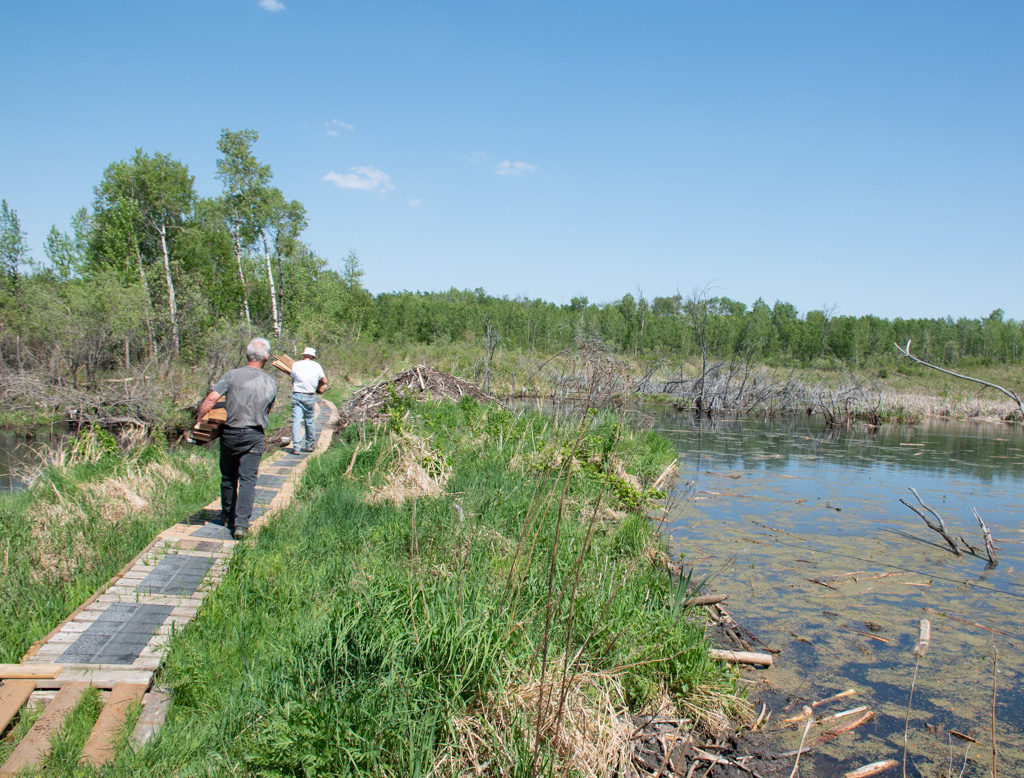
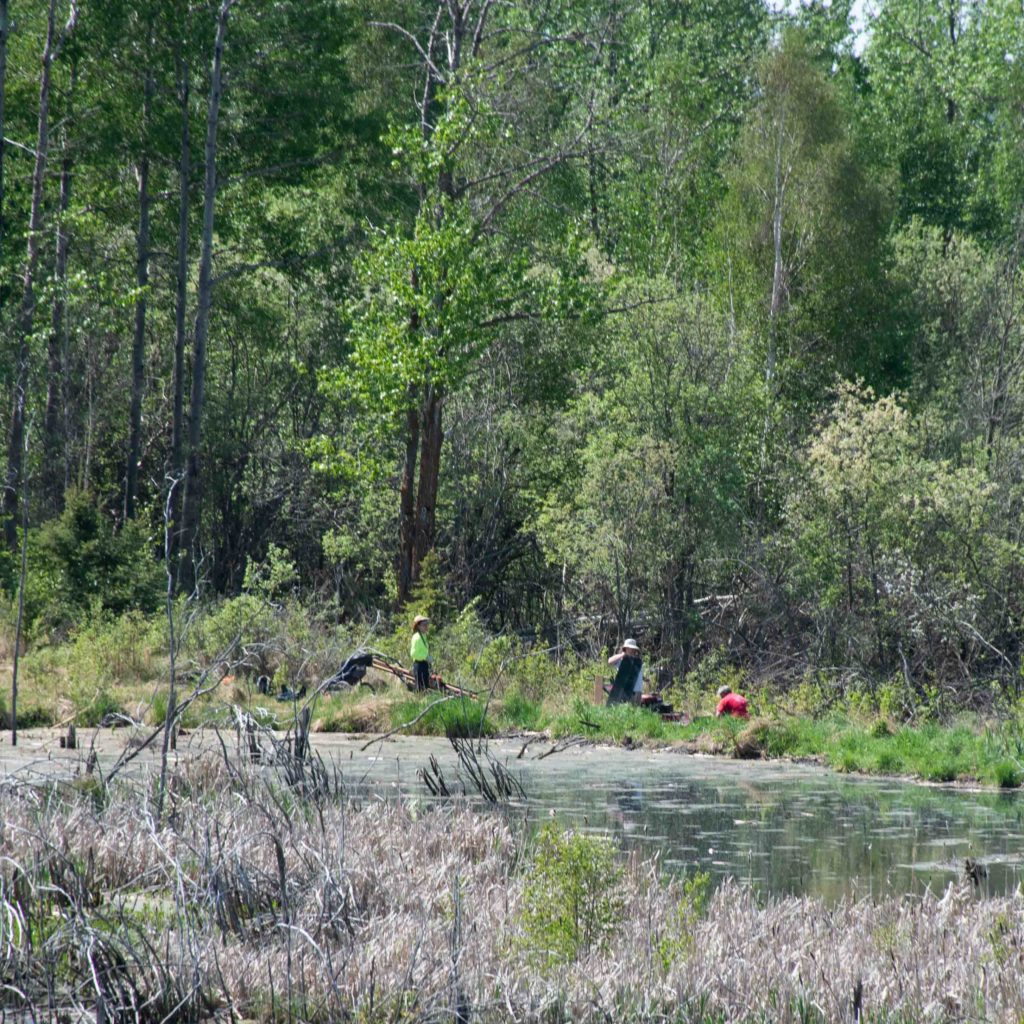
The trail descends to one end of the large beaver pond where the Waskahegan Trail Association (WTA) had to build a new wooden walkway over a beaver re-flooded trail area in 2017. The beavers promptly built over part of the walkway. Eventually beavers and humans reached a compromise.

One can search many solitary dogbane plants in some years and find no flowers or seed pods later in the season as shown here. At the first sign of autumn frost, the plant’s leaves go bright yellow.

[/lgc_column]

Photos by permission of Patsy Coterill from January 2018 Newsletter of the Edmonton Native Plant Group